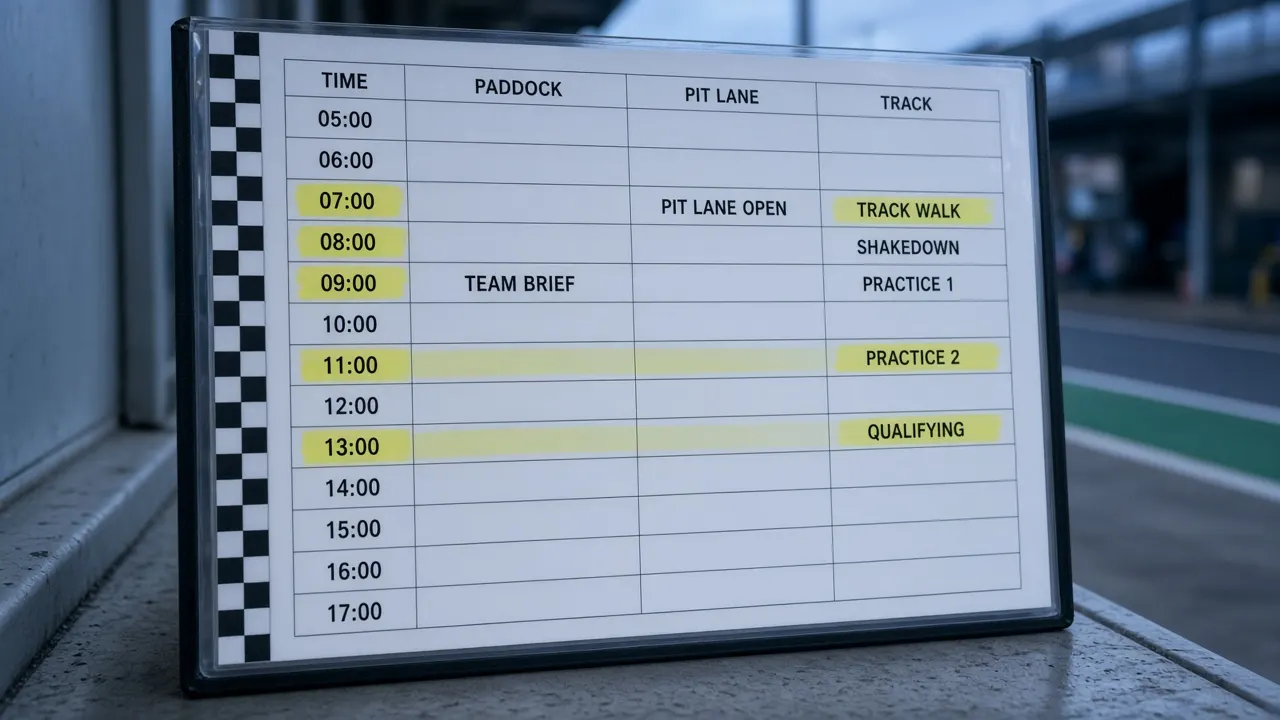
A race weekend is a stack of PDFs that happens to include a drive. This article is the stack, written out so you can plan without asking a rebuilt heritage domain to invent a fixture list.
racetime.com.au will not tell you what is on this Sunday. The calendar guide is the short version of that refusal. This journal piece is the long weekend method.
Step 0 — name the sport honestly
“Racing” is not a governing body. If you are in a car or on a motorcycle at a permitted circuit, you are in the Motorsport Australia world or the matching motorcycle administration — this guide stays with the four-wheel NCR stack we cited. If you are on foot, you are in Australian Athletics or a community event that may only look similar. If you are on a bike, you are in AusCycling or a social bunch that hired a mat.
Mixing those calendars into one colourful widget is how people enter the wrong sport.
Step 1 — open the front door, not a reseller
- Motorsport: motorsport.org.au and the national regulations
- Running: athletics.com.au/event-calendar
- Cycling: auscycling.org.au and the technical regulations hub
Write the URL you used in your notes. If you cannot remember where you saw the date, you do not have a date. You have an ad.
State bodies and promoters are second doors. They are valid. They must still resolve to a permit or a licence.
Step 2 — collect the document stack
On the day you enter, download:
- the calendar or series page (as a PDF or a dated screenshot of the official page)
- the supplementary regulations or technical guide
- the category sporting regulations if they sit in a separate book
- any already-published bulletin
Put them in a folder named with the official meeting title, not “this weekend.” Future you will thank present you when two meetings blur.
Search the supp regs for timing words: transponder, timekeeper, chip, beam, photo finish, results, hire. Copy the paragraph into your notes. That paragraph is the only timing promise that exists.
A 2026 ARDC NSW Motor Race Championship circular that requires a MYLAPS TR2 is an example of such a paragraph. It binds that meeting. It does not bind a different club’s sprint.
Step 3 — treat weather as a bulletin, not a vibe
The historic site already pointed at the Bureau of Meteorology. Keep doing that. Wet circuits change start procedures. Heat changes road-race start times. Wind changes whether a track mark is even a conversation.
Check BOM the morning you re-check the timetable. If a bulletin and BOM disagree about whether a session can run, the bulletin is the sporting decision and BOM is the physical world. Officials get to reconcile those. You do not, from a couch.
Step 4 — plan the timing admin before the fuel
The unglamorous list that actually ruins weekends:
- Is the transponder charged, hired, or already on the bike plate?
- Do you know the mounting diagram?
- Do you know where to return a downhill chip?
- Do you know when provisional results are posted and how to inquire?
- Do you know that this website cannot do any of that?
If a step needs a person, use the contact on the official PDF. The contact form here is editorial.
Step 5 — after the meeting, save the published file
Live boards die. Stories inflate. The published classification is the only number that should enter a training log as a performance.
If the published file never appears, you still have a weekend. You do not have a performance. That distinction keeps honest people honest.
What the archive used to do, and why we will not
/1998cal.htm, /cals/bathurst.htm, /?page=newcal&year=2006 — those were calendars. They now 301 to the calendar guide. /racedata/ timesheets stay 404. The temptation to “just put a table back” is the temptation to lie with yesterday’s accuracy.
A 2005 Energy Breakthrough page that thanked RaceTime Computing for a timing archive is a citation about the old service. It is not a current calendar, and this journal is not that service.
A one-page weekend card you can copy
- Sport / governing body / front-door URL
- Official meeting title
- Permit or licence reference if shown
- Timing paragraph (quoted from the PDF)
- BOM check (date and forecast type, not a number we invent)
- Bulletin numbers read
- Transponder admin done (yes/no)
- Published result saved (yes/no)
If a line is blank, the weekend is not planned. It is hoped.
Travel days without invented start times
This site will not tell you when to leave home. It will tell you which documents change that decision.
A bulletin that shortens a Sunday race is a timing document as well as a sporting one: the zero may stay the same while the distance changes, which changes how you should read a “best lap” later. A BOM warning that a road race has moved its start is a timing document because gun time is about to mean a different clock on the kitchen wall.
Pack for the PDF in your folder, not for the PDF you remember from last year. Layouts change. Curfews change. Transponder hire desks move from “at scrutiny” to “online only.” The organiser is allowed to do that. Your memory is not a regulation.
Sharing a weekend with other people
If you are a parent, a team manager or a volunteer, the same stack still applies. The difference is that you may be holding someone else’s transponder. Write the serial on the same card as the meeting title. Return the downhill plate. Do not let a junior leave a venue with issued hardware because “the app already has their time.”
If two family members are in two sports on the same weekend, do not merge the calendars. A Motorsport Australia permit and an Australian Athletics licence are not one colour-coded spreadsheet away from being the same administration.
Guest posts and third-party lists
Other websites will keep publishing blended calendars. Some will be careful. Some will scrape. If you cite this journal, cite it for the method, then link the governing-body page for the date. Do not cite us as the date. We will not have one.
Related reading
The calendar guide is the short refusal to be a fixture list. Motorsport, running and cycling apply the method per code. Training is what you do with the published file after you drive home.
Hope is a poor Chief Timekeeper.
What “events guide” means on this domain
The 2026 brief calls this site a timing and events guide. Events, here, means literacy: how a sanctioned meeting is announced, how a technical guide names a clock, how a bulletin moves a start, how BOM sits beside a timetable. It does not mean a second calendar competing with Australian Athletics or Motorsport Australia.
If you came from a 1998 bookmark, that distinction is the entire rebuild. The old pages listed meetings because the old company timed them. The new pages teach you to find meetings because we are not that company, and we will not pretend the trailer is already packed.
Volunteers, media and the same stack
If you are timing-adjacent — a volunteer on a mat, a club webmaster, a reporter — the method does not relax. Your job is still to know which document is in force. A volunteer who tells a runner “the chip is official” without reading the event instructions is inventing a house rule. A reporter who publishes a live overlay as a classification is inventing a result. A webmaster who scrapes three sports into one widget is inventing a governing body.
Cite the front door. Quote the timing paragraph. Mark the bulletin number. That is how an events guide stays a guide.
If you reprint this method elsewhere, keep the refusals with it. A method without the refusals becomes, within a week, another unofficial calendar with our sentences as decoration. We would rather you linked Motorsport Australia, Australian Athletics or AusCycling than this paragraph. They are the publishers of dates. We are the publisher of how to read them.
The weekend you can prove is the only weekend that exists. If you cannot prove it from a governing-body page and a PDF, leave the trailer in the shed and open the front door again. That extra hour is calendar literacy. It is also how you avoid becoming the person who packed for a meeting the permit never covered. Prove it, then pack. Not the other way around.