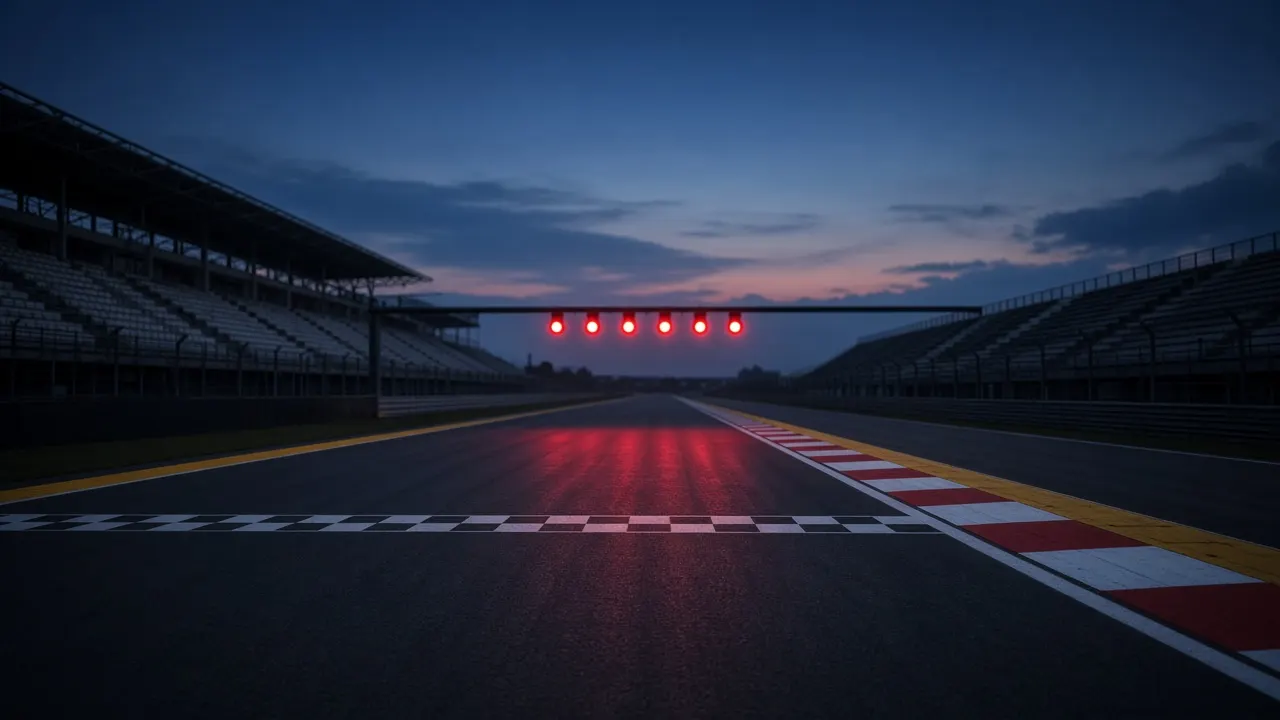
Australian circuit racing still runs on a simple geometric idea: a control line. The Motorsport Australia National Competition Rules define that line as the place where timing or another performance criterion is determined. The start line is the first control line. The finish line is the last. Everything a spectator shouts about “the time” is an argument about when a car’s reference point crossed one of those lines.
This hub does not replace a category’s sporting regulations. It tells you how to read them.
What the 2026 manual actually says about the start
The 2026 Motorsport Australia manual is explicit enough to quote in paraphrase, not invention. Unless the supplementary regulations say otherwise:
- For a standing start, timing begins when the start signal is given.
- For a rolling start, timing begins when the first automobile crosses the start line after the start signal.
- On a circuit, each automobile is then timed as it crosses the control line from the end of the first lap.
That is why two cars can leave the grid in different seconds and still share a race clock, and why a rolling-start field is not “timed from lights” in the same way as a standing-start sprint. If a meeting writes a different method into the supp regs, the supp regs win. Read them.
The Chief Timekeeper is not a TV graphic
Chapter-level duties in the same manual give the Chief Timekeeper a short, unglamorous list:
- keep the timing equipment compliant with the relevant standard
- prepare and sign the timing results
- distribute those results to the Secretary of the Event
- if asked, copy them to the Stewards and to Motorsport Australia
- ensure results are not made widely available until the Secretary publishes them
The Chief Timekeeper is also a Judge of Fact for the order of automobiles crossing the finish line in a competition decided wholly or partly by time. That is the opposite of a live app’s “unofficial” board. If you are arguing a result from a phone screenshot, you are arguing with the wrong document.
How to read a sheet without inventing a story
A typical circuit meeting produces practice, qualifying, warm-up and race files. They look similar and they do not mean the same thing.
Practice is usually unrestricted running with a clock attached. A fastest lap there is information, not a grid.
Qualifying is the session whose sporting regulations convert a lap time into a starting position. The same transponder, the same loop, a different legal consequence.
Race files add elapsed time, laps completed, safety-car notes and the classification. A driver who did not take the chequered flag may still be classified if the sporting regulations say so; that is not a timing question, it is a classification question.
When the old racetime.com.au domain listed “standard results” beside a RaceView page, it was already teaching that distinction: one file for people, one for a richer viewer. This rebuild will not host either file. It will keep telling you they are different.
Transponders, loops and the thing the loop cannot see
Most Australian circuit organisers now require a specified transponder. Supplementary regulations for Motorsport Australia-permitted meetings routinely name the unit and whether hire is available. A 2026 ARDC New South Wales Motor Race Championship circular, for example, states that the organisers use an automatic system that requires a MYLAPS TR2 transponder. That is a meeting instruction, not a national monopoly, and it is not an endorsement on this page.
A transponder answers “when did this unique transmitter pass this loop?” It does not, by itself, answer “was the car legal, was the pass under yellow, did the driver serve a penalty, or did the finish-line camera show a different order?” Those questions stay with the Clerk of the Course, the Stewards and, where fitted, the photo-finish or judicial camera.
If your category still uses a manual board and a handheld watch at a hillclimb or a khanacross, that is also timing. The NCR still want equipment that meets the relevant standard and a signed sheet. Do not assume a national circuit system applies to a club dirt meeting.
Calendars and the temptation to scrape
The historic site kept year-by-year calendars and, later, a PHP ?page=newcal index. Those pages died with the archive. Current fixtures belong on Motorsport Australia’s own channels and on the promoter’s permit page. This hub will not reconstruct a 1998 Bathurst weekend or invent a 2026 one.
If you are trying to plan a season, use the calendar guide. If you are trying to interpret a lap time you already have, stay here, then read training for how athletes misuse official clocks.
Tracks, maps and records — heritage without the table
Wayback captures of /cctmaps.htm and /records/records.htm show state-by-state circuit lists and a lap-record picker. After 2007 the tracks page itself warned that motor-racing tracks were no longer maintained. Copying those tables would republish stale names, including closed venues, and would violate the “no invented or recycled records” rule.
What remains useful is the habit: know which layout you are talking about. A “Sandown time” that does not specify the international circuit versus a historic layout is not a time you can compare. Official results and the circuit operator’s current map are the sources. This page will not draw you a pirate track map.
A weekend checklist for competitors
- Confirm the permit and the category sporting regulations, not just the Facebook event.
- Read the timing paragraph in the supplementary regulations: which unit, which mounting, which hire desk.
- Fit the transponder where the regulations say, not where the last team taped it.
- Treat every session file as labelled — practice is not qualifying.
- If you believe a loop missed you, use the meeting’s inquiry process. The Chief Timekeeper’s sheet is the document, not this website.
Motorsport timing is a legal process wearing a stopwatch. Read it that way and the paddock gets quieter.